Public Key
Learn about Public Key in our Web3 security glossary.
What is a Public Key?
A public key is a cryptographic address derived from your private key that you can safely share with anyone. It functions like your bank account number, something you give to others so they can send you funds, but it gives them no ability to access or move what’s inside.
In blockchain networks, your public key is mathematically linked to your private key through a process that works in only one direction: you can derive a public key from a private key, but you cannot reverse that process.
Every cryptocurrency wallet you use has a public key underpinning it. Without this system, there would be no way to verify ownership of digital assets or confirm that a transaction was authorized by the correct party.
How It Works
When you create a crypto wallet, your device generates a private key, an alphanumeric string of letters and numbers. This private key derives a public key using elliptic curve cryptography or ECC (a mathematical function designed to be easy to run forward and almost impossible to reverse). Your wallet address, the string of characters you share when receiving crypto, is usually a shortened version of that public key.
When someone sends you funds, the network uses your public key to verify that the incoming transaction is directed to you. When you send funds, your wallet uses your private key to produce a digital signature, and the network verifies that signature against your public key. If they match, the transaction is approved. Nobody involved in that verification process ever needs to see your private key.
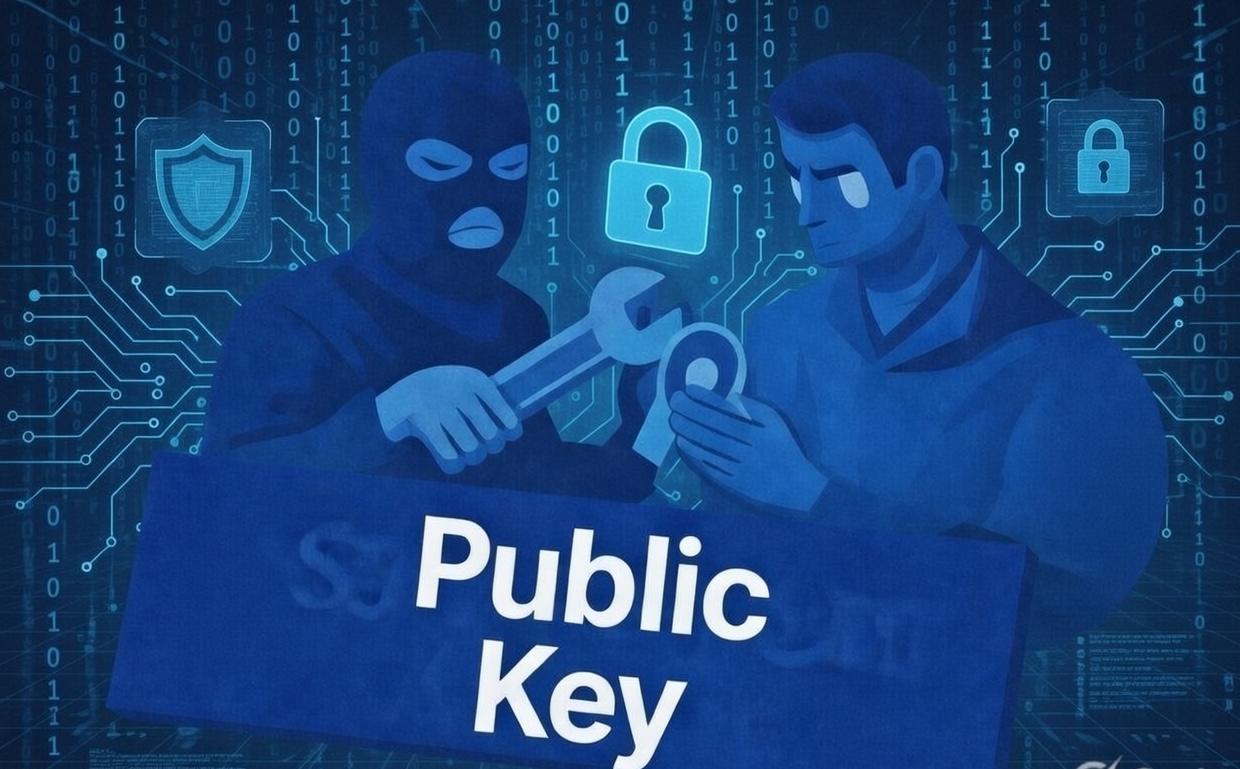
Think of it like a padlock. Your public key is the open padlock you hand to someone so they can lock a message to you. Only you hold the key that opens it.
How to Reduce Risk
-
Store your seed phrase and private key offline and never enter them on any website or app, even one that appears legitimate.
-
Verify wallet addresses character by character before sending funds, as address poisoning attacks exploit the habit of copy-pasting without checking.
-
Use a hardware wallet for any significant holdings, because it keeps your private key isolated from internet-connected devices entirely.
-
Use Kerberus to detect malicious dApps and phishing sites that attempt to trick you into signing transactions that expose or misuse your keys.
Private key compromises were responsible for 43.8% of all stolen cryptocurrency in 2024 according to Chainalysis’s 2025 crypto crime report, with the $305 million DMM Bitcoin hack cited as one of the largest incidents attributed to private key mismanagement.
FAQ:
Q: What is a public key in crypto?
A: A public key is a cryptographic address derived from your private key that you can safely share with others. It works like a bank account number, allowing people to send you funds without giving them any ability to access or move your assets. Every blockchain wallet has a public key underpinning it.
Q: How does a public key work?
A: Your wallet generates a private key, then derives a public key using elliptic curve cryptography, a one-way mathematical function. When you receive crypto, your public key verifies the transaction is addressed to you. When you send funds, your private key produces a digital signature that the network checks against your public key to confirm authorization.
Q: How can users protect their public and private keys?
A: Store your seed phrase and private key offline and never share them on websites or apps. Verify wallet addresses before sending to prevent address poisoning attacks. Use a hardware wallet to isolate your private key from internet-connected devices. Kerberus Sentinel3 can detect malicious dApps that attempt to trick you into exposing your keys.
Written by:
Werner Vermaak is a Web3 author and crypto journalist with a strong interest in cybersecurity, DeFi, and emerging blockchain infrastructure. With more than eight years of industry experience creating over 1000 educational articles for leading Web3 teams, he produces clear, accurate, and actionable organic material for crypto users.
- •8+ years in crypto & blockchain journalism
- •1000+ educational articles for leading Web3 teams
- •Former content lead at CoinMarketCap, Bybit, OKX
Related Terms
See more glossary terms



Install once & immediately get protected from scams, phishing and hacks. Zero losses for 250k+ users in 3 years. Now with up to $30,000 in coverage.