Liquidity
Learn what liquidity means in crypto, how liquidity pools power DeFi trading, and the security risks of providing liquidity in Web3.
Learn what liquidity means in crypto, how liquidity pools power DeFi trading, and the security risks of providing liquidity in Web3.
What is liquidity?
Liquidity is the ease with which a cryptocurrency or digital asset can be bought or sold without significantly moving its price. High liquidity means there are enough buyers and sellers (or enough capital in a pool) to handle large trades with minimal price impact. Low liquidity means even modest trades can cause dramatic price swings.
In traditional finance (TradFi) , liquidity has been a fundamental concept for decades. In Web3, it takes on a different shape. Instead of relying on market makers at banks and brokerages, decentralized exchanges (DEXs) like Uniswap and Raydium use liquidity pools, which are smart contracts filled with paired token deposits from regular users. These users, called liquidity providers (LPs), earn a share of trading fees in exchange for locking their tokens in the pool. The system is powered by AMMs (Automated Market Makers), algorithms that automatically set prices based on the ratio of assets in each pool.
How it works
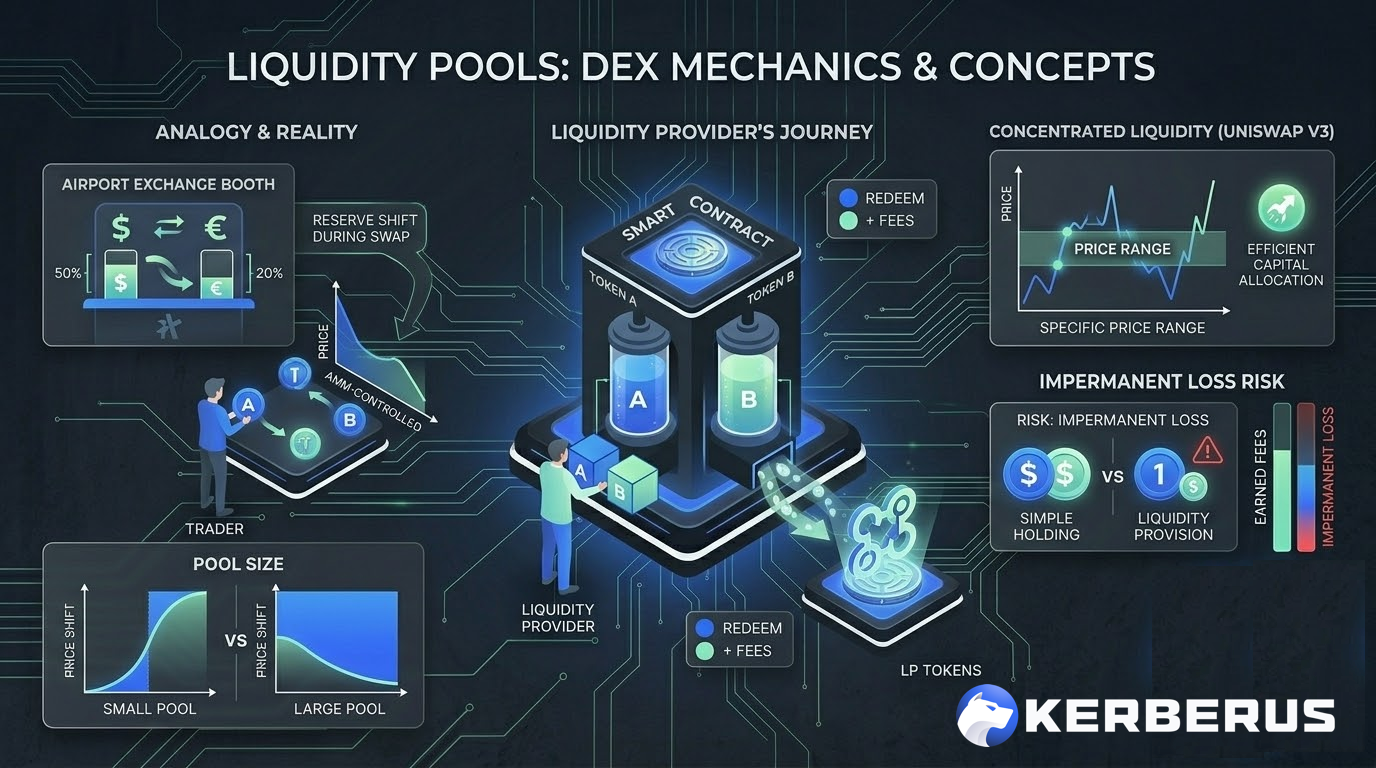
Think of a liquidity pool like a currency exchange booth at an airport. The booth holds reserves of both US dollars and euros. When you hand over dollars and receive euros, the booth’s stock of dollars goes up while its euro reserves shrink. If too many people want euros and nobody brings any in, the “price” of euros at that booth rises.
Liquidity pools on a DEX work the same way, except there’s no attendant. A smart contract holds Token A and Token B. When a trader swaps A for B, the pool’s ratio shifts and the AMM algorithm adjusts the price accordingly. The larger the pool (more liquidity), the less each individual trade moves the price.
Liquidity providers deposit equal values of both tokens into the pool and receive LP tokens representing their share. These LP tokens can later be redeemed for their portion of the pool, including any fees earned. On Ethereum, Uniswap V3 introduced concentrated liquidity, letting LPs choose a specific price range to allocate their capital, boosting efficiency but also adding complexity.
The flipside is impermanent loss. If the price ratio between the two tokens changes significantly after you deposit, you may end up with fewer valuable tokens than if you had simply held them. The trading fees earned often compensate for this, but not always, especially in volatile markets.
Security considerations
- Rugpulls on low-liquidity tokens are extremely common. A project creator can add initial liquidity to a DEX pool, wait for buyers to drive the price up, then remove all liquidity at once, leaving holders with worthless tokens.
- Honeypot tokens are designed so that users can buy but not sell. They appear to have liquidity but the smart contract blocks sell transactions for everyone except the deployer.
- Providing liquidity to unaudited pools on new or unknown DEXs carries high smart contract vulnerability risk. Contract bugs or backdoors can drain the entire pool.
- Low-liquidity tokens are susceptible to price manipulation through flash loan attacks and MEV attacks, where bots exploit thin order books to front-run or sandwich trades at the expense of regular users.
- Always check the total value locked (TVL) and the age of a liquidity pool before trading or depositing. Pools with very low TVL or that were created minutes ago are red flags.
- Use Kerberus Sentinel3 for real-time scam detection and MEV defense when interacting with DeFi protocols.
- Check our Learn academy for top crypto safety information.
Real-world cases
In October 2024, a Radiant Capital exploit drained $58 million from cross-chain lending pools on Arbitrum and BSC after attackers compromised private keys controlling the protocol’s multisig wallet, gaining access to the pools’ liquidity. On Solana, hundreds of memecoin rugpulls throughout 2024 and 2025 followed the same playbook: deploy a token, add liquidity to a Raydium pool, let buyers pump the price, then pull all liquidity. The Chainalysis 2025 Crypto Crime Report noted that exit scams and liquidity pulls accounted for billions in losses across the year.
FAQ
Q: What is liquidity in crypto?
A: Liquidity in crypto refers to how easily a token can be bought or sold without causing significant price movement. High-liquidity tokens like Bitcoin and Ethereum can handle large trades with minimal slippage, while low-liquidity tokens can see wild price swings from even small transactions.
Q: What is a liquidity pool?
A: A liquidity pool is a smart contract on a decentralized exchange that holds paired deposits of two tokens. Traders swap against this pool instead of matching with individual buyers or sellers. Users who deposit tokens into the pool earn a share of trading fees, but take on impermanent loss risk if token prices move significantly.
Q: How do liquidity rugpulls work?
A: A project creator adds liquidity to a DEX pool alongside their newly created token. Buyers start purchasing the token, driving the price up. Once enough value has accumulated in the pool, the creator removes all liquidity at once, draining the pool’s paired asset (usually ETH or SOL) and leaving buyers with worthless tokens that can no longer be sold.
Written by:
Werner Vermaak is a Web3 author and crypto journalist with a strong interest in cybersecurity, DeFi, and emerging blockchain infrastructure. With more than eight years of industry experience creating over 1000 educational articles for leading Web3 teams, he produces clear, accurate, and actionable organic material for crypto users.
- •8+ years in crypto & blockchain journalism
- •1000+ educational articles for leading Web3 teams
- •Former content lead at CoinMarketCap, Bybit, OKX
Related Terms
See more glossary terms


Install once & immediately get protected from scams, phishing and hacks. Zero losses for 250k+ users in 3 years. Now with up to $30,000 in coverage.