Layer-1
Learn what a Layer-1 blockchain is, how it differs from Layer-2 networks, and why its security architecture is the foundation everything in crypto is built on.
What is a Layer-1 chain?
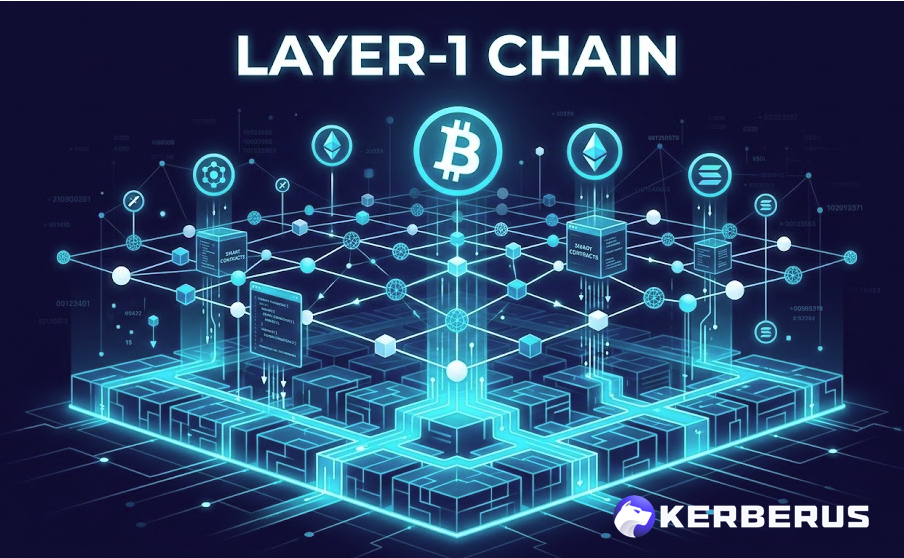
A Layer-1 (L1) blockchain is the base-level network that independently processes, validates, and records transactions without relying on any other blockchain. Ethereum, Bitcoin, and Solana are all Layer-1 networks. They each maintain their own consensus mechanism (the rules by which network participants agree on what transactions are valid), their own validator or miner set, and their own native currency used to pay for transactions.
Every other protocol, token, dApp, and Layer-2 network ultimately settles its security guarantees back to a Layer-1. It’s the foundation everything else is built on.
How It Works
A Layer-1 blockchain achieves consensus through one of two main mechanisms. Proof of Work (PoW), used by Bitcoin, requires miners to expend computational energy solving mathematical puzzles in exchange for the right to add a block of transactions. Proof of Stake (PoS), used by Ethereum since its 2022 Merge upgrade, requires validators to lock up (“stake”) ETH as collateral. If they behave dishonestly, they lose that collateral. Both mechanisms make it prohibitively expensive to attack the network.
The trade-off on Layer-1 is throughput.
Ethereum processes roughly 15 to 30 transactions per second on its base layer, compared to Visa’s tens of thousands per second. This limitation is intentional: decentralization and security come at the cost of speed. Scaling solutions (Layer-2 networks) address throughput while borrowing their security from the underlying L1.
Security threats specific to Layer-1 networks include 51% attacks, where a single entity gains majority control of the validation process and can rewrite recent transaction history, and consensus-layer exploits that target the protocol’s own code.
In December 2025, the Flow blockchain suffered a $3.9 million breach when an attacker exploited a vulnerability in its execution layer and moved assets off-network through bridges to Ethereum before validators could halt transactions, as reported by Crypto Briefing.
How to Reduce Risk
-
Research the consensus mechanism and validator set size of any L1 blockchain you use before committing significant assets. Smaller networks with fewer validators are more vulnerable to 51% attacks.
-
Avoid leaving assets on Layer-2 bridges or wrapped token contracts longer than necessary, as bridge contracts represent concentrated attack surfaces connected to L1 security.
-
Understand that L1 security does not automatically protect the dApps and smart contracts built on top of it, always evaluate protocol-layer risks separately.
FAQ:
Q: What is a Layer-1 blockchain?
A: A Layer-1 blockchain is a base-level network that independently processes, validates, and records transactions without relying on another blockchain. Examples include Ethereum, Bitcoin, and Solana. Every protocol, token, and Layer-2 network ultimately depends on a Layer-1 for its fundamental security guarantees. It is the foundation all other crypto infrastructure is built on.
Q: How does a Layer-1 blockchain work?
A: Layer-1 blockchains achieve agreement on valid transactions through consensus mechanisms. Proof of Work requires miners to expend computational energy to earn block creation rights. Proof of Stake requires validators to lock up cryptocurrency as collateral, which they lose if they behave dishonestly. Both make attacking the network economically prohibitive, at the cost of transaction throughput.
Q: How can users reduce risk when using Layer-1 networks?
A: Research the validator set size and consensus mechanism of any L1 before depositing significant assets. Smaller networks with fewer validators are more vulnerable to 51% attacks. Minimize time spent in bridge contracts connecting L1 to Layer-2 networks, as these are high-value targets. Evaluate dApp risks separately from L1 security, they are not the same thing.
Written by:
Werner Vermaak is a Web3 author and crypto journalist with a strong interest in cybersecurity, DeFi, and emerging blockchain infrastructure. With more than eight years of industry experience creating over 1000 educational articles for leading Web3 teams, he produces clear, accurate, and actionable organic material for crypto users.
- •8+ years in crypto & blockchain journalism
- •1000+ educational articles for leading Web3 teams
- •Former content lead at CoinMarketCap, Bybit, OKX
Related Terms
See more glossary terms

Install once & immediately get protected from scams, phishing and hacks. Zero losses for 250k+ users in 3 years. Now with up to $30,000 in coverage.